
AEO Page Auditor: Is Your Content Actually Ready to Be Cited by AI?

Table of Contents
- Key takeaways
- What is answer engine optimization (AEO)?
- How AEO Page Auditor works
- 1. Choose what to audit
- 2. Add the details
- 3. Run the audit
- 4. Review the report
- 5. Share, export and revisit
- The 12 criteria
- What to fix first
- AEO Page Auditor vs. other My PR Manager tools
- Who AEO Page Auditor is for
- Frequently asked questions
- What's the difference between AEO and SEO?
- Can I audit content before it's published?
- Why didn't my URL audit capture the whole page?
- Does the report give me a score?
- How many audits can I run?
- Get your content ready for AI search
The way people search is changing. More and more questions are answered directly by AI, whether that's Google's AI Overviews, ChatGPT, Gemini or Perplexity, which summarise information from websites and cite their sources instead of just showing a list of links. Ranking well in traditional search doesn't guarantee your content will be picked up and quoted by these answer engines. They favour content that is clear, well structured and easy to quote accurately. AEO Page Auditor in My PR Manager checks your pages and drafts against 12 criteria that affect how well AI systems can understand and cite your content, and gives you a ready-made AI-optimized rewrite for every issue it finds.
Key takeaways
- Audit a live page on your website by its path, or paste content to check a draft before publishing.
- Choose the content type, such as article, product page, landing page or service page, so it's judged appropriately.
- Get a report covering 12 AI-readiness criteria, from dates and authorship to key takeaways and statistics.
- For each issue, see the original text, what's wrong and an AI-optimized rewrite you can use.
- Keep every report in Audit History, and share it or download it as a PDF.
What is answer engine optimization (AEO)?
Answer engine optimization (AEO) is the practice of making your content easy for AI-powered search tools to understand, trust and quote. Traditional SEO focuses on ranking a page in a list of results. AEO focuses on being the source an AI answer is built from.
AI systems extract individual passages, so content works best when each section makes sense on its own, questions are followed by direct answers, facts have context, and it's clear who wrote the page and when it was last updated. Good AEO also tends to make content clearer for human readers.
How AEO Page Auditor works
1. Choose what to audit
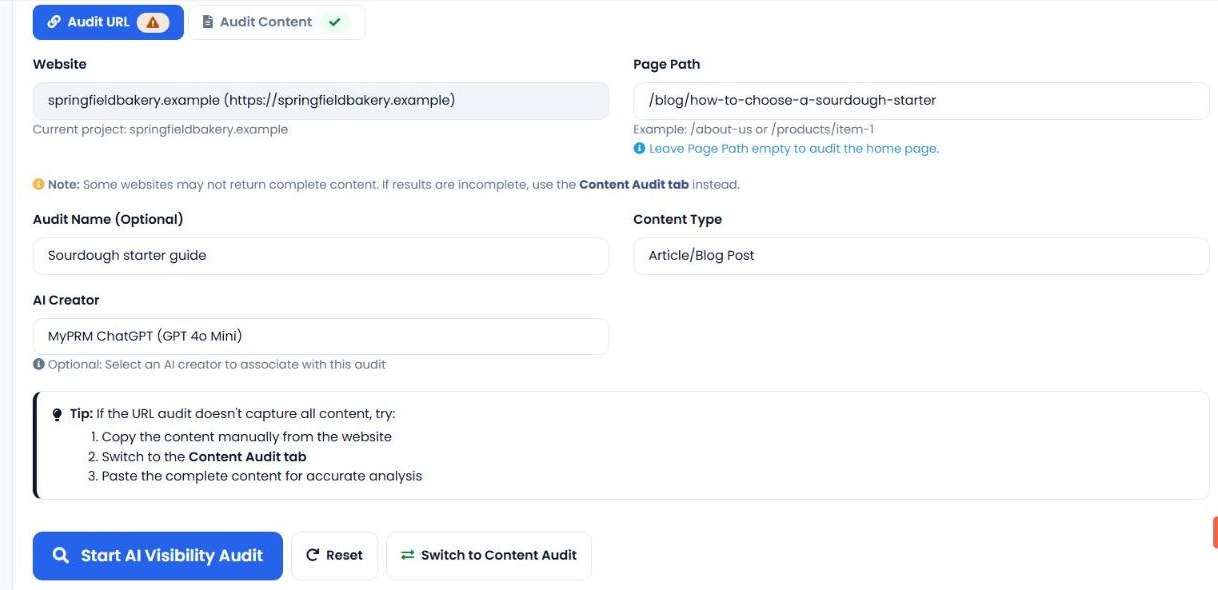
On New AI Visibility Audit, use the Audit URL tab to check a page on your current project's website: just enter the page path, or leave it empty to audit the home page. If a page relies heavily on JavaScript and doesn't fetch fully, switch to Audit Content and paste the text instead. Audit Content is also ideal for checking drafts before they go live.
2. Add the details
Give the audit a name (optional), choose the content type, from Article/Blog Post, Product Page, Landing Page, Service Page or Other, and optionally select the AI creator to use. The page shows how many audits you have left this month.
3. Run the audit
Click Start AI Visibility Audit. The content is analysed against 12 criteria that affect how easily answer engines can understand and cite it.
4. Review the report
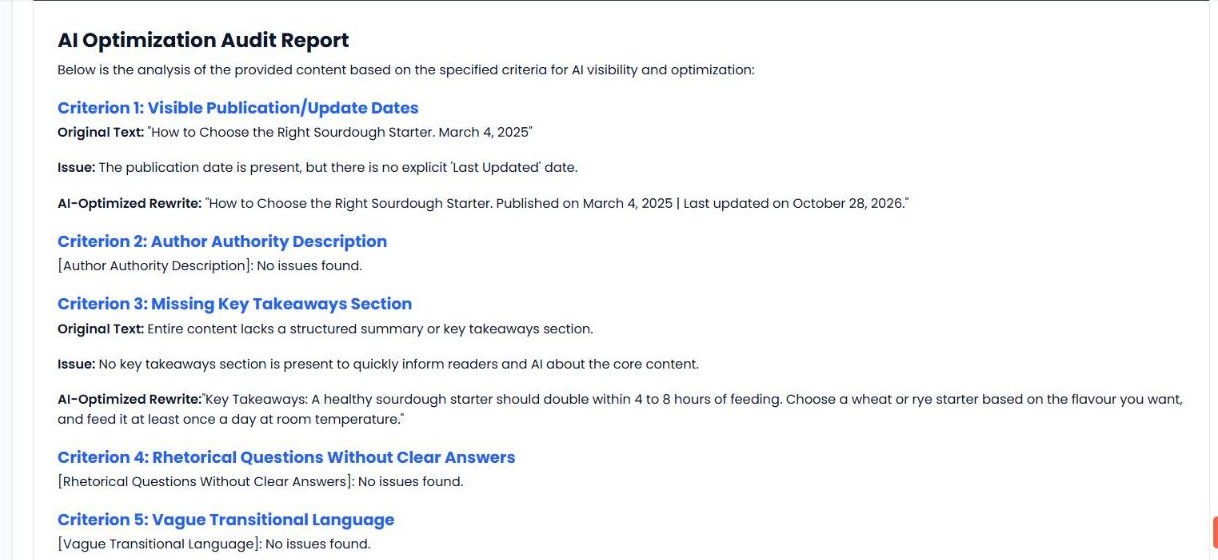
The AI Optimization Audit Report goes through each criterion in turn. Where it finds a problem, it shows the original text, explains the issue and gives an AI-optimized rewrite you can copy straight into your page. Where everything's fine, it simply says no issues were found.
5. Share, export and revisit
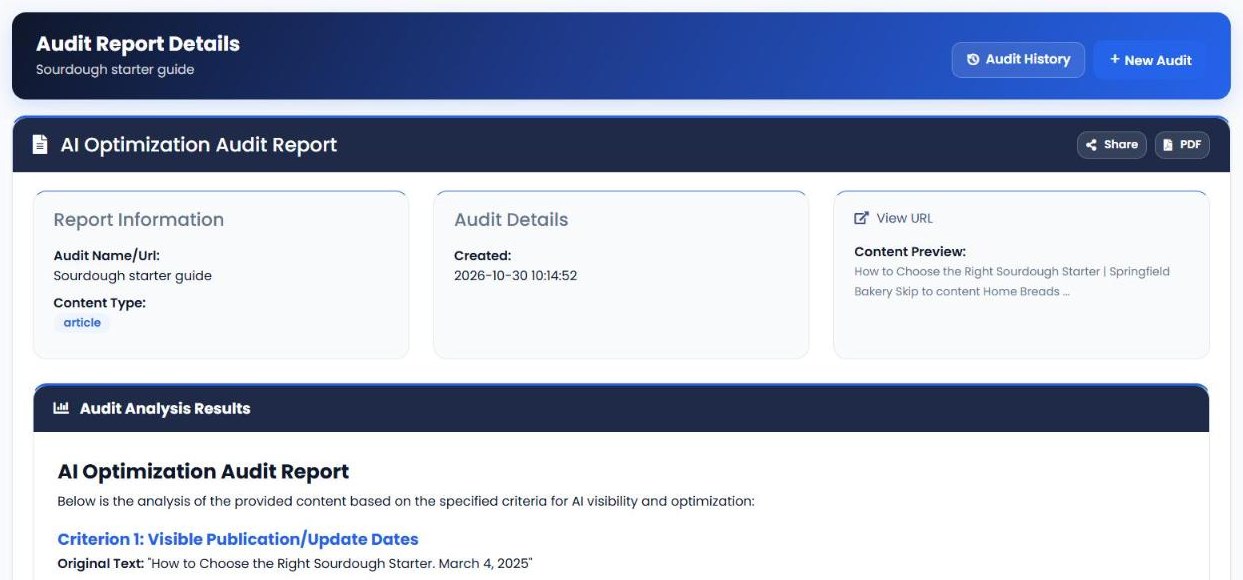
Each report can be shared or downloaded as a PDF. Every audit is saved in Audit History, where you can search past audits and open any report again, for example to check your changes against the original findings.
The 12 criteria
| Criterion | Why it matters for AI answers |
|---|---|
| Visible publication/update dates | Clear published and last-updated dates show the content is current. |
| Author authority description | Who wrote it and why they can be trusted. |
| Missing key takeaways section | A short summary AI can quote directly. |
| Rhetorical questions without clear answers | Questions should be followed by direct answers. |
| Vague transitional language | Phrases like "as mentioned above" lose meaning when quoted alone. |
| Embedded social media without context | Embeds need a sentence explaining what they show. |
| Disconnected list items | List items should make sense on their own. |
| Vague subsection introductions | Each section should say clearly what it covers. |
| Conversational filler language | Filler words make answers harder to extract. |
| Inconsistent punctuation/formatting | Consistent formatting helps machines parse content. |
| Uncontextualized statistics | Numbers need a source, date and meaning. |
| Implied connections between concepts | Relationships should be stated, not assumed. |
What to fix first
- Add a key takeaways section. A short summary near the top gives AI a ready-made answer to quote.
- Show dates and authorship. A visible last-updated date and an author description build trust with readers and AI alike.
- Answer questions directly. If a heading asks a question, answer it in the first sentence underneath.
- Give statistics context. Say where a number comes from, when it was measured and what it means.
- Make every section stand alone. Remove "as mentioned above" and similar phrases, so passages still make sense when quoted on their own.
AEO Page Auditor vs. other My PR Manager tools
| Tool | Main job | Use it when |
|---|---|---|
| AEO Page Auditor | Check content for AI answer engine readiness, with rewrites. | You want your pages to be cited in AI answers. |
| Article Rewrite Manager | Refresh old blog posts automatically with AI. | You want to update a whole archive of content. |
| Article Publisher | Create and publish new articles. | You need new content to audit and publish. |
| Webmaster Tools | Show Search Console clicks and positions. | You want to see how improved content performs in search. |
Who AEO Page Auditor is for
- Content writers and editors who want to check drafts before publishing.
- SEO consultants and agencies preparing clients for AI-driven search.
- Small business owners who want their service and product pages to appear in AI answers.
- Bloggers and publishers who want their articles cited as sources.
Frequently asked questions
What's the difference between AEO and SEO?
SEO aims to rank pages in search results. AEO aims to make content easy for AI answer engines to understand and quote. They overlap a lot, and good AEO usually supports good SEO.
Can I audit content before it's published?
Yes. Use the Audit Content tab and paste your draft.
Why didn't my URL audit capture the whole page?
Some websites load content with JavaScript or block automated fetching. If the results look incomplete, copy the page text and use Audit Content instead.
Does the report give me a score?
It gives you something more useful: a check against each of the 12 criteria, with the exact text that needs changing and a suggested rewrite.
How many audits can I run?
It depends on your plan. The audit page shows how many audits you have left this month.
Get your content ready for AI search
AI answers are becoming a major way people find information. Sign in to My PR Manager, open AEO Page Auditor, and see how ready your most important pages are to be quoted.
Related guides: Article Rewrite Manager · Article Publisher · Webmaster Tools · Keyword Position Checker


